Complete parents’ guide to

Childhood bedwetting is a common and often misunderstood issue for families. When a child wets the bed at night, it is rarely related to behaviour, motivation or parenting approaches. In most cases, bedwetting reflects normal developmental differences in bladder control, sleep patterns, or physiology.
Persistent bedwetting can be frustrating, tiring and lonely for all involved. This page provides clear, evidence-based information about childhood bedwetting (nocturnal enuresis), along with practical guidance to help you understand the issue and the available treatment options.
What is primary nocturnal enuresis?
All kids wet the bed sometimes, especially when toilet training. Primary nocturnal enuresis is the clinical term for persistent bedwetting that continues past the toddler years.1 It refers to a child who involuntarily wets the bed more than 4-6 times per month.2



How common is nocturnal bedwetting?
Childhood bedwetting is far more common than many families realise. Around the country, many other parents like you are comforting their child and changing wet sheets in the middle of the night.
Around 15% of 5-year-olds wet the bed.3 That’s 1 in 6. They’re not doing it on purpose!
While the number reduces each year as they mature, some children continue to wet the bed into later childhood and adolescence.

Important points for parents
- Bedwetting is considered developmentally normal in younger children.
- Boys are more likely to wet the bed than girls.4
- Children do not wet the bed on purpose.
- The stigma attached to persistent bedwetting can add to emotional distress and affect your family’s quality of life.4
- Nocturnal enuresis is a medical condition and treatment is available.

What causes bedwetting?
There is no single cause of childhood bedwetting. For most children, it is the result of a combination of developmental, biological, and neurological factors.
Understanding these underlying contributors is important, as it helps guide appropriate management.
Delayed bladder development
Some children’s bladders mature more slowly. Their bladders do not yet have the capacity to hold the volume of urine they produce overnight.5
Deep sleep and arousal difficulties
Many children who wet the bed are very deep sleepers. They may not wake when their bladder is full or when their body signals the need to urinate.6
Night-time urine production
Some children produce a larger volume of urine overnight than their bladder can comfortably hold.7
Genetics
Bedwetting often runs in families. If one or both parents wet the bed as children, their child may be more likely to do the same.8
Constipation
A full bowel can place pressure on the bladder and interfere with normal bladder function.9
Neurodevelopmental factors
There may be associations between bedwetting and conditions such as ADHD. This does not mean ADHD causes bedwetting, but the two can co-exist in some children.10
Will bedwetting go away on its own?
For many children, bedwetting does reduce with age. Each year, a percentage of children naturally stop wetting the bed as their nervous system, bladder capacity, and night-time hormone regulation mature.
However, it is not always helpful to “just wait and see”, particularly when:
- Your child is older than 7 years.
- Bedwetting is frequent and persistent.
- Your child feels embarrassed, anxious, or distressed.
- Bedwetting is affecting sleep, school camps, or social activities.
- You’re finding it increasingly difficult to manage nighttime disturbances.
- There has been little improvement over time.

At what age does bedwetting stop?
There is no single age that applies to all children. While some children stop earlier, others may continue into later childhood or adolescence without appropriate support.
Treatment options for childhood bedwetting
There are several evidence-based options for managing childhood bedwetting. The most suitable approach depends on the child’s age, development, motivation, and underlying factors.
Education and reassurance
Understanding that bedwetting is common and unintentional is a crucial first step. Reassurance helps reduce shame and blame, which can otherwise worsen stress for both children and parents.
Behavioural strategies
These may include:
- Encouraging regular daytime toileting.
- Managing evening fluid intake without restricting fluids excessively.
- Addressing constipation where present.
Bedwetting alarms
Bedwetting alarms work by helping a child’s brain learn to respond to bladder fullness during sleep.
Medical assessment
In some cases, a doctor may recommend further assessment or short-term medication, particularly for older children or adolescents. Talk to your GP if you’d like to explore these options.
Practical tips for parents
- Reassure your child that bedwetting is not their fault.
- Avoid punishment, teasing, or expressing frustration.
- Use mattress protectors to reduce stress around accidents.
- Involve your child in solutions in an age-appropriate way.
- Keep communication calm and matter-of-fact.
- Seek guidance if bedwetting is affecting your child’s confidence or wellbeing.

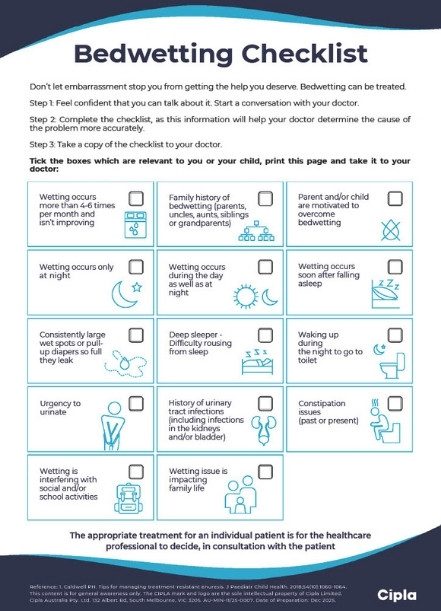
Bedwetting checklist
Starting a conversation about bedwetting isn’t always easy. That’s why we’ve created a checklist for you to complete and discuss with your child’s GP.
Next steps
Childhood bedwetting can be difficult to navigate, but it often improves with the right understanding and support, guided by evidence-based treatment.
Book an appointment with your GP to discuss your options.

Disclaimer
All information is general and not intended as a substitute for professional advice.
References
- Arda E, Cakiroglu B, Thomas DT. Primary nocturnal enuresis: a review. Nephrourol Mon. 2016;8(4):e36209.
- Caldwell P, Ng C. Bedwetting: a practical approach to assessment and management. Med Today.2008;9(6):16-24.
- Rincon MG, Leslie SW, Lotfollahzadeh S. Nocturnal enuresis. In: StatPearls [Internet]. Treasure Island (FL): StatPearls Publishing; 2023.
- Adisu MA, Habtie TE, Munie MA, Bizuayehu MA, Zemariam AB, Derso YA. Global prevalence of nocturnal enuresis and associated factors among children and adolescents: a systematic review and meta-analysis. Child Adolesc Psychiatry Ment Health. 2025;19(1).
- Cammisa I, Ferrara P. The predictive role of bladder ultrasound in children with nocturnal enuresis: a comprehensive overview. Children (Basel). 2025;12(4):520.
- Pedersen MJ, Rittig S, Jennum PJ, Kamperis K. The role of sleep in the pathophysiology of nocturnal enuresis. Sleep Med Rev. 2020;49:101228.
- Tsuji S. Criteria for nocturnal polyuria in nocturnal enuresis. Pediatrics International. 2021 Nov;63(11):1275–6.
- Jørgensen CS, Horsdal HT, Rajagopal VM, Grove J, Als TD, Kamperis K, et al. Identification of genetic loci associated with nocturnal enuresis: a genome-wide association study. Lancet Child Adolesc Health. 2021;5(3):201 – 209.
- Hsiao YC, Wang JH, Chang CL, Hsieh CJ, Chen MC. Association between constipation and childhood nocturnal enuresis in Taiwan: a population-based matched case-control study. BMC Pediatr. 2020;20(1):35.
- Abd-Elmoneim N, Elsheshtawy E, Elsayed M, Elhabiby M, Ibrahim S, Elrefaey H, et al. Comorbidity between enuresis and attention deficit hyperactivity disorder: a case-control study. Middle East Curr Psychiatry. 2020;27:32.